

Why Safety Is the Top Priority in Newborn Photography
August 7, 2026
By Kavitha Nagaraj | Kavitha Nagaraj Photography, Bangalore
There is a moment that happens at every newborn session I photograph.
The parents hand me their baby. Sometimes five days old. Sometimes eight. And in that moment, no matter how carefully they researched, no matter how many photographs of mine they looked at before booking, there is a flicker of something in their eyes. A question they may not have put into words yet.
Is my baby safe?
It is the right question. It is the most important question. And it deserves a real answer from someone who has been doing this for eight years and has never once taken that question lightly.
Why is newborn photography a high-responsibility practice?
A newborn is not simply a small human. Their neck muscles have not yet developed enough to provide proper support, while body temperature regulation is still maturing. In addition, a newborn’s sensitive skin reacts easily to different surfaces, fabrics, and the length of time spent in one position. During the first few days of life, the nervous system continues adapting to the world outside the womb.
In newborn photography Bangalore parents are trusting a photographer with all of this. Not just with capturing a beautiful image but with making hundreds of small decisions in the space of three to four hours, each one affecting the comfort and safety of a baby who cannot tell you when something is wrong.
This is why experience in newborn photography is not interchangeable with enthusiasm or aesthetic talent. Safety knowledge is developed through years of repeated sessions, during which a baby’s cues are carefully observed and professional instincts are gradually strengthened.
What does safety actually look like during a newborn session?
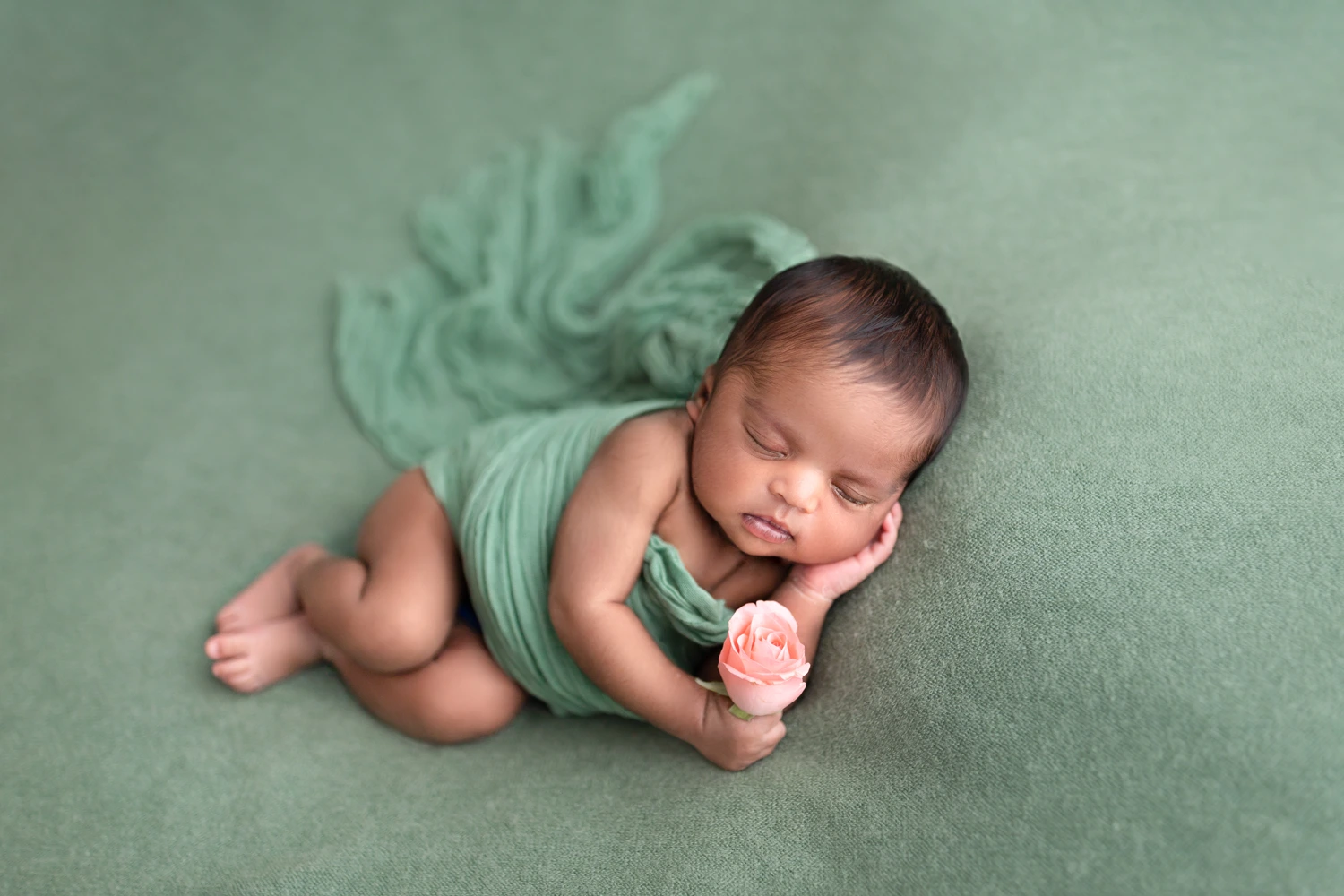
Parents often imagine safety as a single precaution. A spotter present. A padded surface. The truth is that safety in newborn photography is a continuous practice throughout the entire session. It is not a checklist you tick at the start and then move on from.
Temperature comes first, always
Newborns cannot regulate their own body temperature. A room that feels comfortable to an adult can be too cool for a baby who has just been unwrapped. In our studio in OMBR Layout, Banaswadi, we maintain a specific room temperature for every session and monitor it throughout. For at-home sessions we bring portable heating to ensure the baby’s environment is consistently warm regardless of the season or the air conditioning in the home.
Every position is supported at all times
There is no moment in a safe newborn session where a baby is unsupported. No pose, however simple it looks in the final photograph, happens without the photographer’s hands or a proper support in place. The images that appear effortless are the result of careful, sustained physical support throughout.
In newborn photography Bangalore families see online, the final image rarely shows the full picture of what went into creating it. What looks like a sleeping baby resting peacefully is the result of patient settling, precise positioning and continuous monitoring throughout.
Composite images for poses that need them
Some of the classic newborn poses that parents request, such as the baby’s head resting in their own hands, are actually composite images. Two or more photographs are taken with a spotter present and then carefully merged in editing. The baby is never left unsupported to achieve these poses. If a photographer tells you otherwise, that is worth paying attention to.
Reading the baby throughout the session
A settled, deeply sleeping newborn is a photographer’s best indicator that the session is going well. When a baby stirs, fusses or shows any sign of discomfort, the correct response is always to stop and address the baby’s needs first. Feeding breaks, settling time and quiet pauses are not interruptions to a safe newborn session. They are part of it.
After eight years of newborn photography in Banaswadi and across Bangalore, this instinct is something I no longer think about consciously. It is simply how the session moves.
Hygiene without exception
Every fabric, wrap, prop and surface that comes into contact with a newborn is cleaned between sessions. Hands are washed before handling any baby. This is not a policy we mention in passing. It is a non-negotiable standard that applies to every session without exception, whether in our studio or at a client’s home.
What questions should you ask a newborn photographer about safety?
Before you hand your baby to anyone, you have every right to ask these questions directly. A photographer who takes safety seriously will not hesitate over any of them.
1. How do you achieve the poses that appear in your portfolio?
The answer should reference support, spotting and compositing where relevant. If the answer is vague or focuses only on how the image looks, ask again.
2. How do you manage the room temperature during a session?
For studio-based newborn photography in Bangalore, the photographer should be able to describe exactly how they maintain a warm environment. For at-home sessions, they should explain what they bring to ensure the baby’s temperature is managed even if the home is air-conditioned.
3. What happens if my baby becomes unsettled during the session?
The answer should be unhurried and practical. Feeding breaks, settling time, the session adapting to the baby’s pace. Any answer that suggests the photographer works around the baby’s distress rather than responding to it is worth noting.
4. How do you clean your equipment between sessions?
Specific and matter-of-fact. Not a general assurance but an actual description of what the process looks like.
Why newborn photography in Banaswadi at KNP is built around safety first
At Kavitha Nagaraj Photography, safety is not a feature of our sessions. It is the foundation they are built on.
Our studio in OMBR Layout, Banaswadi, Bangalore is a space designed specifically for newborn and maternity work. When we carry our full professional kit to at-home sessions across Bangalore, every safety standard we maintain in the studio travels with us.
In eight years of newborn photography in Banaswadi and across the city, I have never compromised the safety of a baby in my care. In eight years of newborn photography in Banaswadi and across the city, I have never compromised the safety of a baby in my care—not under time pressure, to achieve a particular image, or for any other reason.
That is not something I say to impress you. It is the only way I know how to do this work.
Frequently asked questions about safety in newborn photography
1. Is newborn photography safe?
Yes, when it is practised by an experienced photographer who understands infant handling, temperature management and safe posing. Newborn photography in Bangalore, like anywhere, ranges significantly in the level of care and training behind it. The questions above will help you identify a photographer whose safety practice is genuine rather than assumed.
2. What age is safest for a newborn photoshoot?
The first five to fourteen days after birth. At this stage newborns sleep deeply and settle well, which means the session can move gently without the baby being handled more than necessary. As babies grow past three weeks they become more alert and the deep settled sleep that allows for safe, calm photography becomes less reliable.
3. Are the poses in newborn photography dangerous?
The poses that look most delicate, such as a baby appearing to balance in their own hands, are composites created from multiple supported images. A trained and experienced newborn photographer understands which poses require compositing and will never attempt to achieve them unsupported.
4. How do I know if a newborn photographer in Bangalore is truly safety-trained?
Ask them directly. Ask about their posing approach, how they manage the baby’s temperature, what their hygiene practice is between sessions and how they handle a baby who becomes unsettled. The quality and specificity of the answers will tell you everything you need to know.
5. Does Kavitha Nagaraj Photography offer newborn photography in Banaswadi?
Yes. Our home studio is in OMBR Layout, Banaswadi, Bangalore and most of our newborn sessions take place here. We also travel across Bangalore for at-home sessions, bringing the same professional equipment and the same safety standards to every home we work in.
If you are expecting and would like to talk about a session, reach out through the inquiry form on this website. I reply personally to every message.
Kavitha Nagaraj is a luxury newborn and maternity photographer with a home studio in OMBR Layout, Banaswadi, Bangalore. She also offers at-home sessions across Bangalore and travels across India for the right booking. With eight years of experience photographing families across the country, she specialises in slow, unhurried sessions that produce photographs families hold on to for generations.